SIPS Month 3: The Cost of Coping
Month 3 follows the path from coping to active recovery and examines how a part-time retail schedule can claim more than its paid hours.


I thought a part-time job would take up part-time space in my life. A shift might take a few hours; the rest of the week would be mine.
In September, I found out the shift was only the visible part. The days around it had jobs too: winding down from one shift and prepping for another.
This on top of trying to recover from a major depression episode last month made me realize I'd hit a mental and physical limit. I could do some things again, but I was still tired, low, and still not reliably well.
I've started calling that stretch between crisis and active recovery "the coping phase".
Previously, at SIPS…
Last month, I wrote about the long tail of recovery and how my functional capacity can return before the rest of me catches up. Sleep and wearable signals didn’t always match how recovered I felt. This month, I followed what came after the crisis — and what it took to keep showing up before I felt better again.
Month 3 findings (Sept 6 - Oct 5)
1. Coping was its own phase.
This episode of depression was a persistent one, but I still noticed I was able to bounce back sooner. I was on my way to recovery by late August when shit came crashing down.
My Medicaid application had been rejected, our car needed repairs again, and the stress just added up, so I had a mini-crash or "recovery blip". That was Sept 1 and by Sept 6 I could tell things were calming down. I had a little more room to function, including some freelance work. But depression, heaviness, low energy, poor appetite, and trouble keeping up with basic care were still there.
Being able to great through the day could make it look as if I were doing better across the board. I wasn’t.
The crisis can ease before recovery does. A rough day can happen inside a longer stretch of progress. In the Evidence Locker, coping is still an emerging finding. I want to watch it for a few more months before I can say where it begins and ends.
2. My interest came back before my stamina did.
On Sept. 11, after about two days mostly at home, I got an unexpected invite to take a blacksmithing class. I was like, please, get me out of the house! I had a good time and was proud of myself, but it was very physical work so I crashed the rest of the day.
By Sept. 12, my creativity, curiosity, wanting to help, and enjoying people’s company were coming back. I counted it as day one of active recovery. The heaviness hadn’t lifted, and sleep still wasn’t restorative. I wanted to do things before I had the stamina to do them without paying for it later.
I saw a smaller echo in early October. On Oct. 3, I was craving one specific food and wanted to make chapatis from scratch, a several-step project I chose for myself. By Oct. 5, sleep felt restorative, my mood was good, and I had more energy. I could manage travel, cleanup, and a social outing. My back and hips were still a little tight.
Self-started interest is a clue I want to keep watching, not a test that says I’m all better. I was also using a lot of cannabis during parts of Oct. 1–4, which could have shaped how I felt. I don’t want to overread the example.
3. The shifts took up more than the shift.
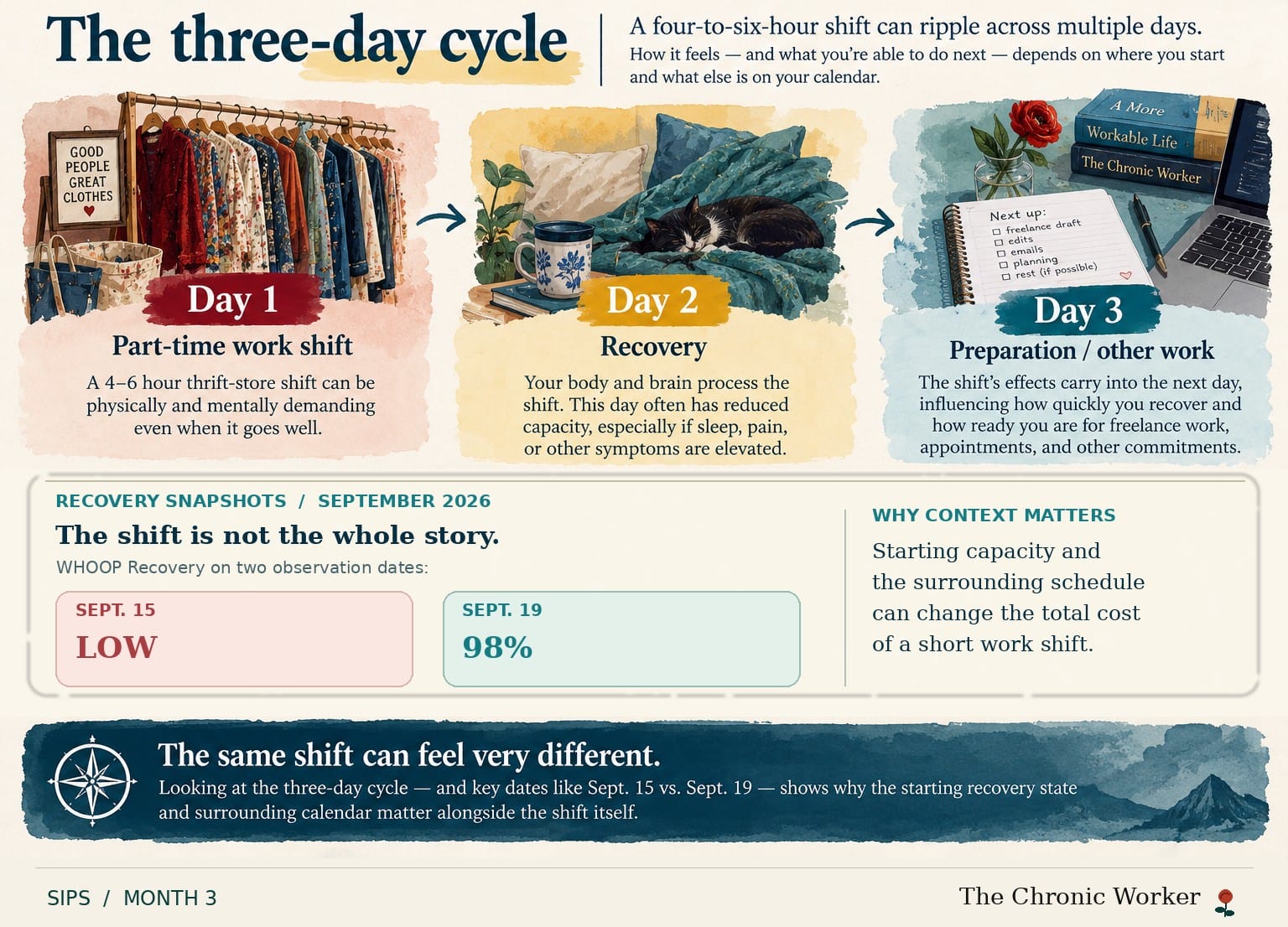
The thrift shop job gave me a pattern to notice. From Sept. 15 -19, I worked every other day and spent the days in between recovering or prepping for my next shift.
WHOOP gave me another layer of context. On Sept. 15, I worked from a low Recovery score, logged 6.7 Day Strain and more than 13,000 steps, then had an energy crash. ChatGPT logged that I redistributed some of my to-dos to other days so I could rest.
On Sept. 19, I logged a similar number of steps and 8.2 Day Strain after waking to a 98% Recovery score. By Sept 23 my logged Recovery was down to 58%.
Looking only at the shift misses the conditions around it. How much capacity I have going in and what fills the days around it seem to matter too. Some days without a shift still held client work, deadlines, SIPS reporting, choir, or household chores. The physical load might lessen while my brain stayed on the clock.
For me, this is a workability question. On paper, the job was part-time. In practice, recovery and preparation could take up most of the surrounding week. I’m treating that as a pattern in my experience, not a formula for anyone else’s capacity.
4. The last shift wasn’t the end of recovery.
After my final shift on Sept. 26, I kept seeing low Recovery and feeling soreness in my back and hips for several days. On Sept. 30, I slept more than 11 hours, but the wearable score was still in the red. By Oct. 5, my sleep felt restorative, my mood and energy were good, and my back and hips were only a little tight.
It looks like recovery continued after the recurring shifts stopped. That doesn’t prove the job caused it. Depression, sleep disruption, travel, cognitive deadlines, and other demands were all in the mix.
Explorer field notes
My record is uneven. Early September has direct daily reports for some days; Sept. 10 is an MVR. Later entries draw on dated recollections and WHOOP summary screenshots rather than a complete raw export. When I don’t know the exact timing or how a day felt, I want the record to say so. A neat timeline isn’t worth making one up.
By the end of the retail experiment, work had also made it harder to backfill SIPS reports with much detail. That gap is part of the evidence too. When reporting gets harder during the exact moments we want to understand, it needs an easier way to capture them. I shouldn’t have to reconstruct a perfect account later.
Three Months of SIPS: Our first quarterly review
July 6–October 5, 2026
Three months ago, SIPS began with a deceptively simple question: What happens when I stop trying to fix my body and start paying attention to how it actually works?
Ninety-some days, three monthly reports, and quite a few unexpected detours later, we found that activity, pacing, and predictable routines appeared more sustainable than pushing hard on good days or resting completely on bad ones. Recovery was cumulative, and physical and cognitive energy didn’t always move together.
Month 2 challenged our assumptions about recovery. A prolonged depressive episode revealed that feeling better, functioning better, and actually recovering are three different things. Mood could rebound while physical exhaustion persisted. Even positive sleep data couldn’t tell the whole story.
Month 3 put workability to the test. Our retail experiment brought the relationship between activity, recovery, and external demands into sharper focus. The same kind of shift could produce different outcomes depending on the starting recovery state and surrounding calendar. Being capable of doing something, we discovered, doesn’t necessarily make it sustainable.
The research changed, too
Perhaps our most important methodological discovery was that observation itself has a cost.
Daily reporting became difficult precisely when the information might have been most valuable. Missing entries, abbreviated observations, voice memos, and retrospective reconstruction taught us something about the limits of conventional self-tracking.
The method had to adapt to the person, not the other way around.
Our emerging framework now looks beyond isolated symptoms and good or bad days. We’re examining transitions between relative stability, destabilization, crisis, coping, and recovery—and what happens when those processes overlap.
A note from the Explorer
I’m proud of what we’ve built.
Not because we’ve found definitive answers. We haven’t. This is still one person’s experience, and three months is a beginning, not a conclusion.
But we’ve built a working research practice around the realities of chronic illness, tested it against actual life, and started identifying patterns that would otherwise have disappeared into the blur of ordinary days.
Somewhere along the way, SIPS stopped being just an experiment in observation. It became a way of asking better questions.
And that’s worth celebrating.
Three months down. Our first quarter complete.
Now, onward to Month 4.
But first, I think I’ve earned some cake. 🎂
What we’re following next
Month 4 is following transitions among coping, active recovery, relative homeostasis, and destabilization — and how accumulated demands shape those shifts.
My weekly Transition + Burden MVR keeps the report focused on four questions:
- What happened?
- What state was I probably in beforehand?
- What did it cost or displace?
- Did I recover before the next load arrived?
What tends to happen before a crisis?
For mini-crises and larger crises, we’re looking back over the three to seven days beforehand for trigger stacking and unresolved load. The goal is to notice how demands accumulate around a transition, while keeping the timeline honest when details are uncertain.
Which demands are in view?
We’re following clustered freelance deadlines and new recurring obligations as burden cases. The retail shifts are a comparison point for understanding how surrounding demands and starting capacity can change the cost of activity; they are not an active exposure.
Is the observation method workable?
Month 4 observations will help develop Accessibility & Burden toward Field Kit #3. We’ll notice whether the weekly MVR and available support stay usable when capacity is low, and treat reporting difficulty as evidence about the method itself.
Out and about
If you’d like to explore the SIPS chronic life observation method with us, you can join the SIPS Explorer Panel.
What I’m carrying into Month 4
I’m carrying two things forward: coping and active recovery aren’t the same, and a part-time job doesn’t only take the hours on the schedule.
I want to keep looking at what happens before and after visible activity: what it takes to show up, what it takes to recover, and what room is left for the rest of life. That’s where the cost of coping keeps showing up for me.