The tracker isn't the point
Chronic Ways of Working #1 | Jill Knobeloch Mills: Jill built a detailed system to track patterns across health, work, and daily life. Years later, we learn what remained after she no longer needed it.

Chronic Ways of Working is a reported series about what people build when the usual ways of working stop working for them. Each story looks at the systems, compromises, adaptations, and experiments people use to survive when illness or disability changes the rules.
Years ago, Jill Knobeloch Mills built an elaborate system to understand what the hell was happening between her health, mood, energy, work and the rest of her life. When we came back to it in 2026, she told me something I hadn't expected: She doesn't really track anymore.
C-WoW #1 | Jill Knobeloch Mills
Content note: This piece discusses stroke, mental health, chronic illness and the particular joys of navigating the U.S. health care system.
Listen: Before vs After
This story actually started several years ago, when Jill answered a bunch of questions for me in writing about self-employment, health and the detailed tracking system she'd built around both. In September 2026, we came back to that conversation with the recorder running.
The audio edition isn't a reading of this article. It's Jill and me revisiting the system together: how it started, what it taught her, what I borrowed from the general idea for my own health tracking, what happens when you miss days and, eventually, why Jill stopped doing most of it.
Edited C-WoW conversation: approximately 37 minutes
A note on my voice: I have narcolepsy, and when I'm especially tired I sometimes stumble over words, slur them, lose them halfway through a sentence or just sound very obviously tired. You can hear some of that here.
I've left it in intentionally because C-WoW is about meeting people where they are.
“You can keep recording.”
Those are Jill's first words on the recording. She almost hadn't recorded with me that day because she wasn't feeling particularly good.
Which is more or less why I told her we should probably record anyway.
Not because being sick or exhausted makes anyone magically more insightful. Chronic illness just has terrible respect for production schedules, and I'm not interested in building a series about workable lives that requires everyone to show up on their sparkliest possible day.
So Jill told me to keep recording, and we talked for almost an hour. Somewhere in that conversation, while looking back at a health-tracking system she'd built years earlier, Jill gave me the sentence that now feels like the center of this story:
“The tracking served its purpose.”
She didn't find the perfect tracker. She didn't become the world's most consistent self-tracker, and she definitely didn't discover a system everyone else should copy.
The system worked, and then she stopped using it.
That's the interesting part.
Jill needed flexibility long before she needed a tracker.
Jill has spent very little of her adult working life as a conventional full-time employee. Part of that started with hockey.
After college, she was officiating high-level amateur games and traveling enough that a traditional full-time schedule didn't fit particularly well around the rest of her life. She did spend about nine months working full time at an agency, but she was also getting sick constantly.
Eventually, freelance and contract work became less of a temporary arrangement and more of the way she built her career. Which turned out to be fortunate!
At 28, Jill experienced two strokes. The following year included 36 medical appointments and a failed heart surgery, followed by another heart surgery the year after that.
Later, when she pursued pharmaceutical treatment for bipolar II disorder (bipolar depression), she ran straight into another wildly shocking feature of American health care: finding a psychiatrist who took her insurance, had availability sometime before the next geological era, and lived within a remotely reasonable distance. The psychiatrist she found was about an hour and a half away.
At first, they weren't sure Jill could realistically make the regular appointments. Jill could because she controlled her schedule.
This is where conversations about “flexibility” tend to get annoyingly oversimplified. Self-employment didn't make Jill's health problems disappear, turn appointments into leisure activities, or solve the financial cost of being sick.
It did make some of the logistics possible. She could move work around medical appointments, build rest into her schedule, keep officiating hockey, and adjust when she needed to.
But flexibility has a price.
In our earlier interview, Jill described constantly negotiating the line between enough work to make enough money and so much work that her health started falling apart.
Freelancers also don't get paid for plenty of the work required to stay freelancers. There's finding clients, admin, scheduling, planning, following up, and following up again. All that invisible infrastructure has to happen around the work clients actually see.
A consistent long-term client eventually gave Jill a much more stable base. She could adjust her involvement over time and use smaller freelance projects to fill the gaps. Even with that stability, though, a harder question remained:
How do you know you're reaching your limit before you've already blown straight past it?
She didn't start with a polished system.
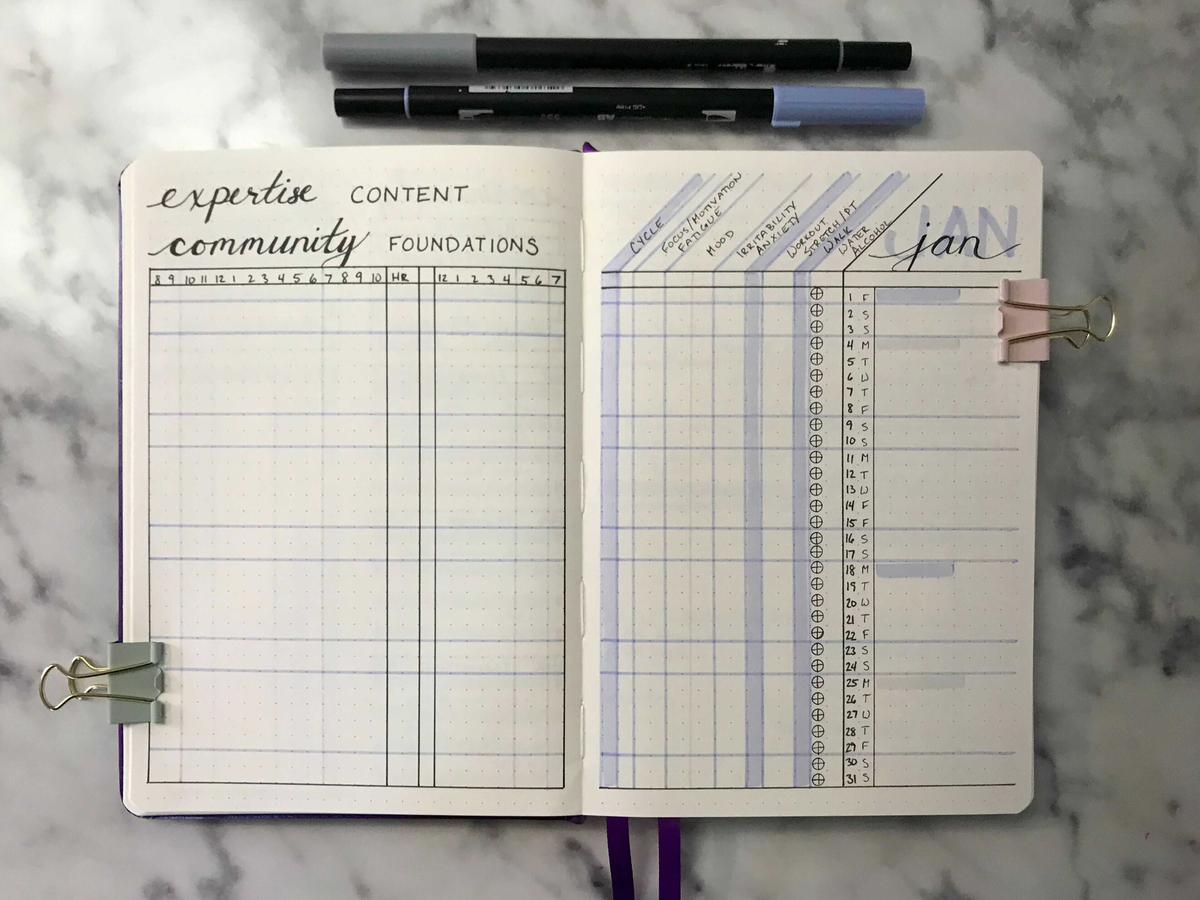
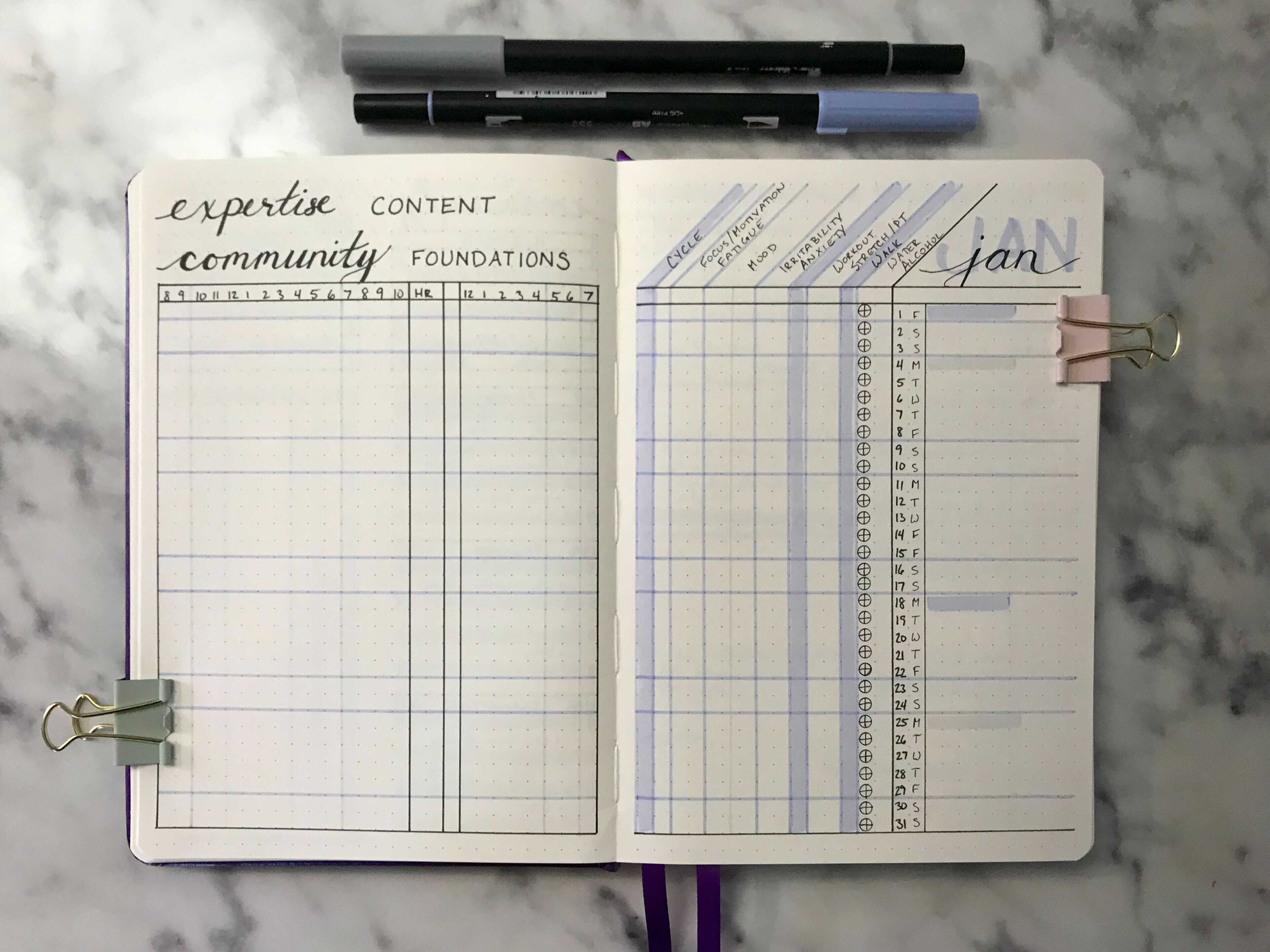
This is one of my favorite parts of the story because if you'd seen Jill's eventual bullet journals, you might assume she emerged from the womb holding six fine-tip pens and a color-coded data taxonomy.
Her psychiatrist initially suggested tracking a few things: mood, sleep, and alcohol intake. Jill wasn't convinced, so it became a experiment. She wasn't starting with 27 metrics, a giant wellness dashboard, or a template. She started with a single question. Does alcohol affect my mood?
That question led to other questions. Eventually, Jill tracked sleep, different mood states, her menstrual cycle, exercise, water, caffeine, situational events, work, and social activity.
The beautiful, intricate bullet-journal spreads I remember weren't Version 1. Jill estimated she spent six to eight months fine tuning her system before it became the version I knew.
Which tells me something else really cool: the tracker was never really finished. Each new version gave Jill another chance to ask whether a piece of information still told her anything useful.
Because if it didn't, why keep collecting it?
The answer was sleep. Sort of.
One of Jill's original questions was whether alcohol affected her mood. It did, but not quite the way she expected. She found that alcohol disrupted her sleep and poor sleep tracked much more closely with changes in her mood.
Years later, she knows that pattern well enough that she doesn't need a journal to point it out.
“My sleep is really the lever.”
That doesn't mean sleep explains Jill's mental health. But it became one of the useful levers she learned to recognize.
Social activity became another. Jill is outgoing, confident and socially capable, but she's also very much an introvert. Her tracking helped her see that too much social activity without enough recovery could contribute to the same kinds of crashes she experienced elsewhere.
This is where things get messy in a way I find extremely useful. Bodies don't particularly care whether we've categorized something as work, health, relationships, or fun. It all comes from the same person.
The person doing the client work is also the person who slept badly, went to the doctor's appointment, had dinner with friends, dealt with the family emergency, and spent three hours driving.
And somehow, that same person is supposed to show up Tuesday morning with a fresh battery because Google Calendar says so. Capacity crosses categories whether our systems acknowledge it or not.
Sometimes the tracker's job is to remember.
Not everything Jill learned from tracking was some grand revelation about cause and effect. Sometimes the journal was useful because the journal remembered.
This comes up in the audio because it's one of the reasons I started building my own observation systems too. A doctor asks how you've been sleeping, how often something happened, how bad your anxiety was, when a symptom started or what happened before it.
You have maybe 10 or 15 minutes, and your brain goes:
Well, I'm sitting upright right now, so probably fine?
Jill could open the journal. Instead of vaguely estimating whether she'd needed an anxiety medication “a few times lately,” she could see how many times she'd used it over the previous two months.
She could look at her sleep, her moods, and the actual period or event she was trying to describe. She didn't have to reconstruct several weeks of being a human from whatever information happened to be accessible in her brain that morning.
That's not diagnosis, and sometimes it isn't even pattern recognition. It's external memory.
When you're dealing with illness, fatigue, depression, brain fog or anything else that makes memory less dependable precisely when the information matters most, external memory is not a small thing.
Jill was not doing this perfectly.
Now we arrive at the dangerous part of showing anyone a beautiful tracking system. It's extremely easy to look at them and conclude:
Absolutely fucking not.
Fortunately, Jill wasn't filling them out with machine-like perfection either. She missed days, sometimes several of them.
Her journal went everywhere with her because it doubled as a planner and working notebook, so she was in and out of it constantly, she says. When information was missing, though, she had other places to look.
Her Fitbit knew about her sleep. Her calendar knew where she'd been. Recent memory could fill in mood or activity, while context helped with smaller details.
If she wanted to reconstruct caffeine intake, for example, knowing whether she'd spent the day at home or bouncing between coffee meetings gave her somewhere to start. A few days later was usually manageable; a week later got fuzzier.
Missing Wednesday did not destroy the experiment.
This is one of the parts of Jill's system that stuck hardest for me. My version looks different: I use WHOOP, ChatGPT and ridiculously small Minimum Viable Reports for days when a full health report can go directly to hell.
Different system, same basic idea. Don't make one exhausted version of yourself responsible for remembering everything.
Give yourself multiple ways back into the record.
Because Jill is right:
“You can't find patterns if you don't have consistent data.”
But she followed that with something just as important:
“Too much data can lose some of those patterns.”
The answer isn't track more. It's track enough.
The same tracker doesn't work anymore
There's another reason I don't want anyone using Jill's old journals as an aspirational standard: She liked doing them. Drawing was creative, and setting up the spreads could be meditative.
She also had enough capacity at that point in her life for the process itself to give something back. Present-day Jill has a different life.
She's remarried, has four stepchildren and runs additional businesses. Her responsibilities have changed, and so has her available capacity. The elaborate tracker that was once useful and enjoyable would now be a giant pain in Jill's ass.
Same person. Same tool. Different accessibility.
We often talk about accessibility as though it permanently belongs to an object. Something is accessible or inaccessible, and that's that.
Real life is ruder than that.
Capacity changes, circumstances change, and the system that saves you during one period of your life can become another unpaid admin job three years later.
Sometimes the person changes because the system worked. And if you needed the system to survive, doesn't letting it go mean you've succeeded?
A tracker should have to earn its keep
Eventually, I asked Jill what she tracks now.
Basically? Not much. She still uses calendars, task lists, Notion and the usual external-brain stuff. The elaborate health-tracking system is gone.
Her health is more stable, and she recognizes many of the patterns she once needed the journal to uncover. Eventually, the tracker also stopped teaching her enough to justify the work it took to maintain.
That's where Jill's story breaks away from the usual self-tracking fantasy. Most tracking systems quietly assume that continuing to track means you're succeeding.
More data. Longer streaks. But why? Jill wasn't trying to become world champion of documenting Jill. She was trying to learn something.
She learned it. The information became portable, her life changed and the cost-benefit calculation changed with it. So the system got to go away.
That is a successful ending.
What I carried into SIPS
I didn't have the SIPS when Jill was making these journals. I had no Minimum Viable Reports, Daily Reports, Evidence Translation, Observation Indexes, Field Kits, or weird little gothic research institute.
I just thought Jill's brain was cool.
She didn't stop at I feel awful. She wanted to know when it happened, what else was going on, whether it had happened before and what had changed.
Most importantly, she wanted to know whether understanding any of it gave her something useful to do next.
Years later, when I started building my own ways of observing chronic illness, those kinds of questions came back. What am I actually trying to learn? What information is worth the effort of collecting? Could something else collect part of it for me?
SIPS isn't Jill's bullet journal with institutional branding slapped on top. But watching how she approached her own questions helped shape the way I approach mine.
Coming back to her years later also gave me something I couldn't have learned while watching the system in action:
A good observation system should be allowed to become unnecessary.
That matters because I don't want to build systems people have to serve forever. I want systems that give something back: information, language, a better question, something useful to tell a doctor, a limit you recognize before you hit it, a pattern, or a decision.
Eventually, maybe they even give you enough self-knowledge that you don't need the system as much anymore.
What I'm taking back into the field
Jill is one person. Her tracker isn't a protocol, and her life isn't evidence that everyone should start bullet journaling their water intake.
No one story is the story.
But there are a few things from Jill's experiment I want to keep:
- Start with something you genuinely want to understand. Add information because it answers a question, not because a template has an empty box.
- Give yourself more than one way to recover missing information. And revisit what you're collecting as the question changes.
- Count the burden of using the system as part of the system. Look across work, health, relationships, and environment instead of pretending your body respects boundaries.
- Let tools change when your capacity changes. Let them shrink or disappear naturally.
The point was never to track forever. It was to notice enough to learn something useful.
Years ago, Jill was trying to make a little more sense of life's chaos. Today, she doesn't need the same map. She learned the territory.
And maybe that's the point.
Learn more about Jill!
When I'm not making her revisit years-old tracking systems with me, Jill's a UX/UI and product designer who runs GrapeSeed Designs. Her work combines graphic design, user experience, product thinking and a longstanding interest in how people actually interact with the things we build.
She also makes actual things. Stellar Moments creates personalized star-map projectors, while Red Wolf Leather & Games is home to her D&D and tabletop gaming tools and accessories.
- GrapeSeed Designs — UX/UI and product design
- Stellar Moments — personalized star-map projectors
- Red Wolf Leather & Games — D&D and tabletop gaming accessories
Keep exploring
Chronic Ways of Working is a reported TCW series about the systems, adaptations, compromises and experiments people build to make work more workable in real life. No one person's system is the system; these are field notes.