What Month One of SIPS Taught Me
This imaginary 1930s travel research institute has become the home of all my health data collection and analysis to help me better understand my body with chronic illness.

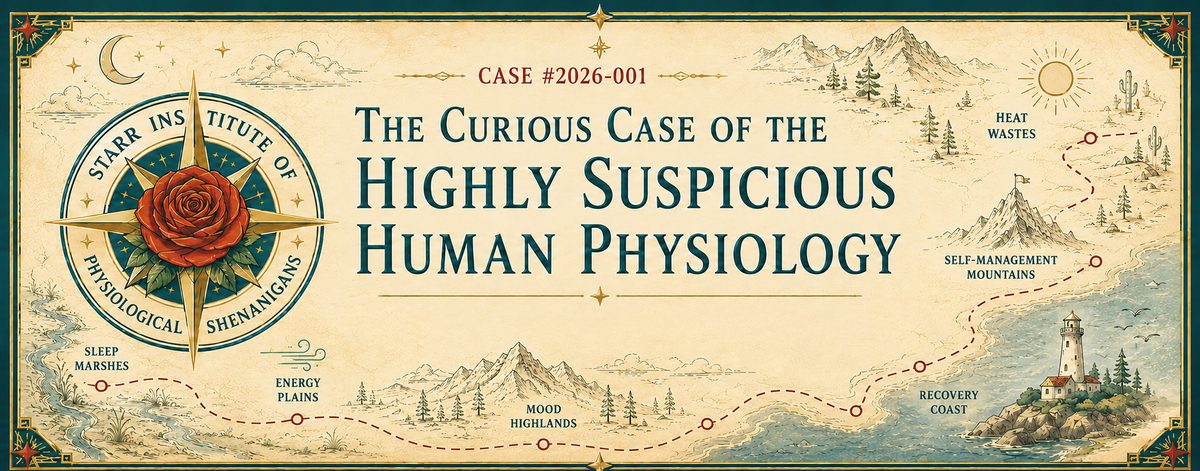
Welcome to the Starr Institute of Physiological Shenanigans, or SIPS, for short!
This imaginary 1930s travel research institute has become the home of all my health data collection and analysis to help me better understand my body with chronic illness.
🎧 Prefer to listen?
Listen to the companion Field Recording for additional insights and commentary...or just because.
SIPS began with a simple frustration as I was juggling insomnia, narcolepsy symptoms, and debilitating depression and PTSD:
Medical care captures single moments, while chronic illness unfolds across weeks, months, and years.
I struggled for nearly two years to get a narcolepsy diagnosis because half the time, my tests didn't match the diagnostic criteria, but all my symptoms did. Why? My current working theory is that either my sleep meds messed with me, or my chronic insomnia skewed the results. But I'm still investigating! That's what SIPS is for, after all.
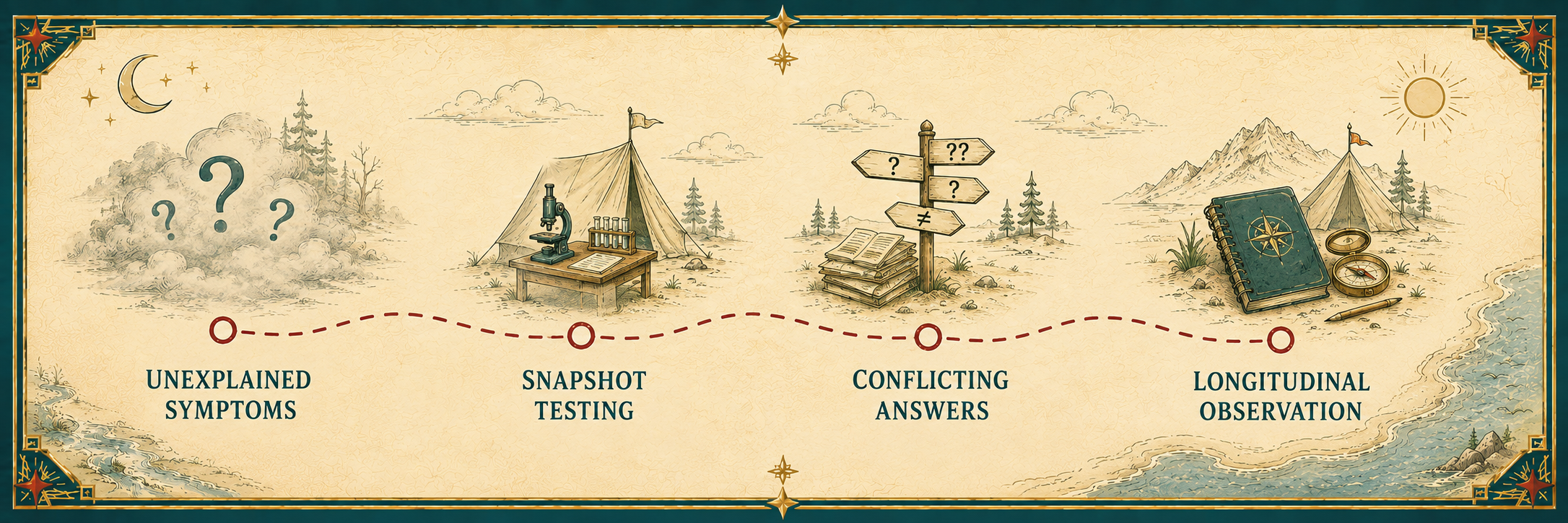
Whyever it happened, it left me annoyed at the healthcare system for requiring expensive, one-time tests to make decisions about chronic illnesses that change daily.
I didn’t want to replace expert medical care or diagnose myself. I wanted better evidence to bring into it.
If a sleep study could only show what my body did on one particular night, I wanted to know what happened across the other 364.
What did my sleep look like over weeks and months?
What happened before a particularly bad day? Did the same patterns keep showing up?
What was changing that I couldn’t remember by the time I got into a doctor’s office?
So I decided to build my own longitudinal record alongside my medical care: something that could help me understand my body over time, ask better questions, and give my doctors more context than I could reconstruct from memory.
And I knew that meant tracking and analyzing a lot of data over time. I'd tried other manual methods (like spreadsheets and calendars) before, but it was just too much to maintain, especially on bad health days when I really needed to collect that data.
But I knew I was on the right track! So I did some research and realized that:
- Wearables could help me fill in data gaps with little-to-no effort, and
- ChatGPT, which I had been using for work, could help me fill in even more gaps.
From there, I built a basic method for combining my daily lived observations with longitudinal wearable data from WHOOP.
And eventually, that method became SIPS.
In SIPS lore, the Institute is a slightly ridiculous 1930s adventure-and-research society run by three sisters: Lila, Scarlett, and Teale. Think women's adventurers' club meets old-school geographical society, except the unexplored territory is chronic illness.
There are investigators, field reports, maps, evidence lockers, research expeditions, and an unreasonable amount of institutional hilarity for an organization that technically exists inside my laptop.
The lore makes the work fun. The work itself is serious.
The purpose of SIPS is to create meaningful insights into how chronic illness works over time, reduce the burden of living with one, and leave field notes for anyone who comes later.
I didn’t start SIPS because I wanted another dashboard to keep up with.
I started it because I was tired of trying to explain my body from memory with severe mental and chronic illness.
The goal was not to optimize myself into productivity-machine nonsense. But to understand what actually helps me live and work more safely.
Now, let's see how I did after a month of tracking!
SIPS Month 1 Findings
Month 1 of tracking ran from July 6-Aug 5 and was essentially a field study of one person:
- Daily lived-experience reports
- Longitudinal WHOOP data
- Weekly reviews for recurring patterns across sleep, recovery, symptoms, workload, environment, and support
These aren't universal findings about chronic illness, just things I've noticed about how my body works within its limitations — and hypotheses I can keep testing.
A month of observation showed me that my chronic illness isn't just about symptoms—it's about the interaction between physiology, environment, workload, support systems, and my body's ability to recover over time.
Here are my ten biggest findings from Month 1:
- My body responds better to consistency than intensity.
Rather than thriving on either complete rest or pushing through, my strongest physiological recoveries occurred after several days of moderate activity and careful pacing. In my Month 1 data, sustainable routines consistently looked better than trying to capitalize on occasional “good days.”
Which brought me to the next insight:
2. Recovery is cumulative, not immediate.
Several consecutive days of lower strain and consistent sleep produced measurable improvements in recovery, HRV, and resting heart rate, while demanding work, travel, and social events often created a physiological and symptomatic "hangover" lasting 24–48+ hours.
3. Physical recovery and cognitive recovery are not the same thing.
One of the clearest findings was that feeling physically recovered did not necessarily mean my brain had recovered. WHOOP frequently suggested my body was ready for activity while I still had significant cognitive fatigue, highlighting the need to track physical and cognitive recovery separately.
4. Good sleep doesn't always prevent daytime sleepiness.
Several documented sleep attacks occurred after objectively good nights of sleep with great efficiency, and substantial REM and deep sleep. While bad sleep clearly makes things worse, the data suggests my EDS and insomnia co-exist. Chaotically.
5. WHOOP-estimated sleep need can recover faster than symptoms.
Long nights and daytime naps generally brought down that need within a day or two, but fatigue, sleepiness, and reduced functioning often persisted. This suggests that correcting sleep quantity alone may not fully restore daytime function.
6. The story contains evidence the numbers miss.
One of my biggest Month 1 discoveries wasn't about my symptoms. It was about how I was collecting them. Manual tracking kept failing because the method demanded too much from me—especially on the days when having good records mattered most.
So I started talking instead and created a system where ChatGPT takes my voice memos and turns them into structured reports. Which turned out to be a good idea because my memos consistently captured context my wearable data and questionnaires couldn't:
- Environmental factors
- Emotional state
- Functional limitations
- Symptom progression
- Daily decision-making
Beginning with the story produced richer evidence than a checklist.
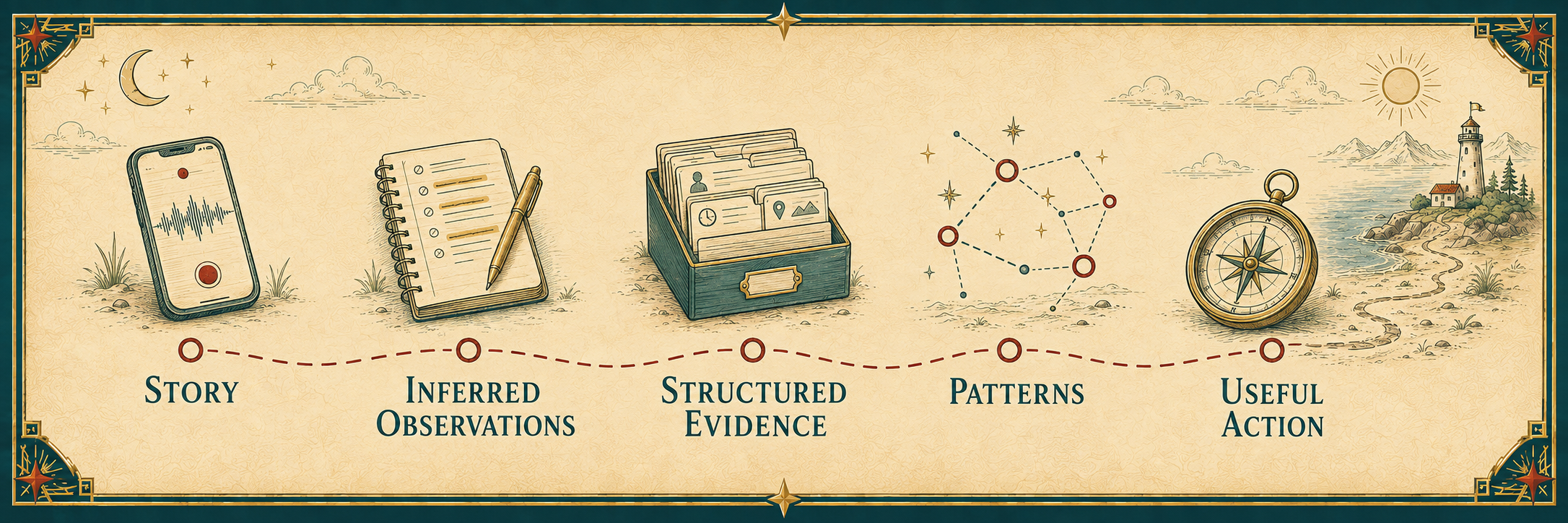
7. Lower cognitive cost produces better research.
The easier I made reporting, the more complete my evidence became.
Reporting every two to three days proved a lot more sustainable for me than daily documentation, especially on bad days. Month 1 established several methodological principles that will guide future observation:
- Narrative first. Scores second.
- Infer before you inquire.
- Capture first. Structure second.
- Question only when necessary.
The goal is to reduce reporting burden while increasing evidence quality.
8. Chronic illness behaves like a system, not a collection of symptoms.
Recovery and daily functioning were influenced by much more than sleep. Workload, travel, alcohol, heat, administrative burden, and social context all interacted with my physiological recovery. Looking at the whole system gave me a much better picture than isolated symptoms.
9. Support is only helpful if it's accessible.
Friends rallied around me during difficult periods, but navigating benefits, paperwork, and disability systems remained extremely difficult because fatigue, executive dysfunction, and memory problems limited my ability to complete the same tasks required for me to get assistance.
Support should be evaluated not only by its availability, but by its accessibility for people with reduced functional capacity.
10. Longitudinal observation reveals what single days cannot.
Perhaps the most important finding of Month 1 is that meaningful patterns only became visible after several weeks of observation. Wearable data, structured observations, and narrative context each captured different parts of the picture, but together they created a far richer understanding of my health than any single source could provide alone.
Month 2 Research Priorities
- Develop a two-axis model of insomnia and excessive daytime sleepiness (EDS), the main symptom of narcolepsy.
- Expand environmental and support-system tracking to include financial stress, physical and cognitive recovery, emotional vs practical support, and more!
- Test whether improvements in practical support reduce symptom burden and improve functional capacity independently of medical interventions.
Want to track your own health? Join me!
Not everyone needs a whimsical research institute in their life, though I highly recommend it. But I do think more chronically ill, disabled, neurodivergent, and exhausted people need low-burden ways to notice what is actually happening.
That is where the Field Kit comes in.
Field Kit #1: The Chronic Life Observation Kit is the beginner version of this process. It is not the full SIPS system. It does not require a wearable, an AI assistant, a spreadsheet obsession, or a perfect memory.
It's a practical starting point for observing your own days without turning your life into a productivity project. It is built for imperfect days. It is built for “I forgot yesterday.” It is built for “I only remember the worst bits.” It is built for people who need evidence but not another exhausting system to maintain.
No AI required. No optimization required. No heroic bullshit.
Get Field Kit #1.
Keep exploring
You can listen to the Month One audio companion or continue with Month 2: The Long Tail of Recovery. For how those observations meet the workday, try self-management techniques for chronic workers.