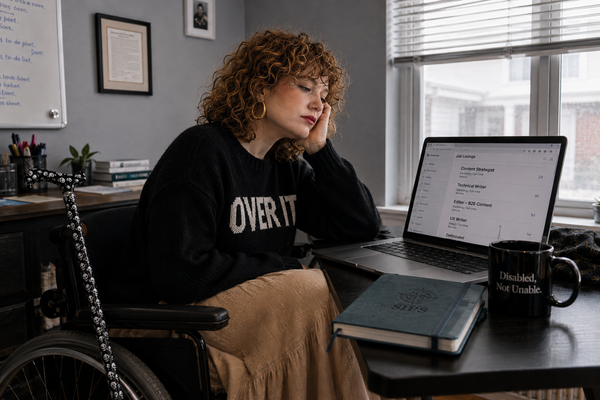
3 reasons you should be hiring disabled workers
Why should you hire disabled workers? I've got three good reasons for you.

And I'm not talking about meeting your diversity quota.
October is National Disability Employment Awareness Month (NDEAM), which is the perfect time to re-examine the demographics of your workforce.
If you haven't knowingly hired disabled workers yet, now is also a good time to ask "Why should I?"
I've got three good reasons for you:
- "Disabled" is not a dirty word.
- We are the largest minority in the world.
- Disabled workers are a massive untapped source of talent.
Let's dive in.
"Disabled" is not a dirty word.
When you think of the term "disabled worker," I'll bet you have a specific idea in mind. You're probably thinking of accessible parking, wheelchair ramps, and nonprofits that hire people with intellectual or developmental disabilities.
In other words, rather than an opportunity to expand your workforce, hiring disabled workers might seem like extra work.
But that's a very skewed, and let's face it, ableist, viewpoint.
According to the Americans with Disabilities Act (ADA), a disabled person is an individual with a...
"Physical or mental impairment that substantially limits one or more major life activities, a person who has a history or record of such an impairment, or a person who is perceived by others as having such an impairment."
Now this is vague for a reason. In fact, the ADA website states that it does not specifically name all the conditions covered. Additionally, disability isn't always a constant. Thousands of conditions have good days and bad days.
Anyone can become disabled for any reason —think a broken leg or chronic illness. Also, many conditions we see as "normal", such as ADHD, can actually qualify as disabilities depending on the person's experience.
Think carefully. Do you, or someone you know, have a disability?
We're the largest minority in the world.
By an absolute landslide. The World Health Organization (WHO) estimates that 1.3 billion people globally have a significant disability. That's about every 1 in 6 people. It's also the population of China.
A 2023 study by Boston Consulting Group reported an even higher global average of 25%.
What about closer to home? According to the Center for Disease Control (CDC), more than 1 in 4, or 28.7% of adults in the US have some type of disability (70 million). So, really, "minority" is a bit of a laughable understatement.
The CDC even breaks down disabilities in the US even further by type of impairment:
- 13.9 percent of U.S. adults have a cognition disability with serious difficulty concentrating, remembering, or making decisions.
- 12.2 percent of U.S. adults have a mobility disability with serious difficulty walking or climbing stairs.
- 7.7 percent of U.S. adults have an independent living disability with difficulty running errands alone.
- 6.2 percent of U.S. adults are deaf or have serious difficulty hearing.
- 5.5 percent of U.S. adults have a vision disability with blindness or serious difficulty seeing even when wearing glasses.
- 3.6 percent of U.S. adults have a self-care disability with difficulty dressing or bathing.
We also represent the most diverse group of all populations, crossing every race, ethnicity, gender identity, sexual orientation, religion, and more. For example, according to the Human Rights Campaign (HRC), one in three (36%) LGBTQ+ adults self-reported having a disability as well as 52% of transgender adults.
Now, it's crucial to note two things:
- These stats are based on adults over 18 years old, so doesn't include disabilities among teens or children.
- These numbers are self-reported. Many people who might "qualify" as disabled under the ADA don't feel comfortable disclosing a disability. In fact, Disability:IN found that less than 5% of workers voluntarily self-identify as disabled.
So the real number is likely quite a bit higher.
By rejecting the notion of hiring more disabled workers, you aren't just blowing off a few people. You're limiting the opportunities of a significant portion of the workforce, many of whom probably work for you already.
Disabled workers are a massive untapped source of talent.
And no, I don't mean you should hire us because we're supposed to have superpowers. Disabled people have a vast array of skills and talents, and yet are vastly under-employed in the U.S.
According to BLS, the unemployment rate for chronic workers is twice as high as for people without disabilities: 8.3% compared to 4.2% as of August 2024. BCG and Disability:IN found that most organizations report that disabled employees only make up about 4-7% of their workforce.
While that number may be skewed due to the lack of self-disclosure, it still represents a significant gap between chronic workers and their employment status.
The good news: The Center for American Progress (CAP) reported a record high for employment among people with disabilities in 2023: 36.1% of disabled women and 38.2% of disabled men. At time of writing, CAP doesn't include stats for non-binary or LGBTQIA+ workers.
Disabled workers represent a diverse talent pool that until recently, many companies have not tapped. But that is changing!
Stay competitive in the workplace —and your industry— by hiring more disabled workers, and fostering a work environment that includes and supports them.
How to hire more disabled workers
Wanting to hire disabled workers is just the first step. The question is, how can companies attract and retain more workers with chronic illnesses and disabilities?
Here are 5 ways to make employment more accessible for disabled workers:
- Practice accessible hiring: Consider offering interviews with accommodations such as captioning for video calls, ASL interpreters, and objective rubrics for assessing candidates.
- Partner with disability-friendly orgs: Inclusively, Chronically Capable, and Bender Consulting are just a few companies that specialize in hiring disabled workers.
- Offer inclusive benefits: Employee benefits that support disabled workers, such as comprehensive healthcare insurance that covers preexisting conditions, can go a long way to attracting disabled workers.
- Consider your work accommodations: Lean on resources like the Job Accommodation Network (JAN) for insights and guidance.
- Foster a diverse and inclusive environment: Consider how you can best support your workers with resources such as flexible scheduling, employee resource groups, and diversity and inclusion training.
Disability is underrepresented in the workplace; partly because it's broadly misunderstood, and because the work environment still isn't a safe place for self-disclosure.
But companies have a unique opportunity to tap into this massive, underutilized talent pool by practicing inclusive, equitable hiring and retention.
More From Me
- Recently written: 10 signs of burnout and 4 lessons full-timers can learn from freelancers
- Learn more about me and my work
- Listen to the Bettermental Podcast
Keep up with all posts from The Chronic Worker by subscribing today!