12 Job boards and resources for disabled and chronically ill workers
Disabled and chronically ill people like us are criminally underemployed in the U.S. These job boards and resources can help change that.

Update note: Originally published October 2022. Last updated September 2026 with new job boards, current resources, and expanded guidance.
Job hunting when you’re chronically ill or disabled can feel like being handed an unpaid part-time internship at exactly the wrong moment.
You’re not just looking at the usual things: salary, qualifications, responsibilities, location. You may also be quietly calculating:
- Can I physically get there and/or work these hours?
- Is the health insurance decent?
- What happens if I need accommodations?
- Does remote mean remote, or “remote unless someone decides we all need to come in three days a week”?
- Will this job leave me enough energy to feed myself when I get home?
And then, after doing all the sick math, you still have to actually apply. Fun.
The employment gap hasn’t disappeared, either. In 2025, the unemployment rate for people with disabilities was 8.3%, compared with 4.1% for people without disabilities. Disabled workers are also more likely to work part time and be self-employed.
So, rather than sending you into the wilds of the internet with nothing but LinkedIn, Indeed, and a prayer, I’ve collected some job boards and career resources designed specifically for disabled workers—or that offer the kind of flexibility that can make work more workable when you live with chronic illness.
Before we begin:
A job appearing on a disability-focused or “people-first” job board does not automatically make the employer accessible.
Consider these resources starting points, not endorsements. You still get to investigate the job, the company, and whether the reality of the work fits your life.
Disability job boards at a glance
| Resource | Best for | Disability-focused? | Work/opportunity focus |
|---|---|---|---|
| Inclusively Hire | Matching around accommodations and supports | Yes | Employer matching + jobs |
| abilityJOBS | Dedicated disability job search | Yes | Broad job board + accessible career fairs |
| Disability Solutions | Listings + interview/job-search support | Yes | Jobs, training, webinars + career resources |
| Chronically Capable | Chronic illness + flexible work | Yes | Remote, flexible, full-time, part-time + contract; currently paused |
| DisabledPerson.com | Large disability-specific search | Yes | Broad job listings |
| People-First Jobs | Work culture + flexibility | No | Remote/flexible people-first companies |
| Creative Circle | Creative, content + marketing professionals | No | Freelance, contract, temp-to-hire + permanent roles |
| PowerToFly | Larger job pool + virtual networking | No | Remote/hybrid jobs, events + career resources |
| Built In | Tech/knowledge work + employer research | No | Remote/hybrid jobs, company profiles, benefits + culture information |
| CareerCircle | Career support + inclusive hiring | Inclusive; not disability-specific | Jobs, coaching, events + resources |
| FlexJobs | Curated remote/flexible work | No | Remote, hybrid, part-time + freelance |
| USAJOBS + Schedule A | Federal employment | Disability hiring pathway | Federal jobs + disability-specific hiring pathways |
Resources last checked September 2026
Not sure where to start?
Use this quick-start map to choose a resource based on what you need most right now.
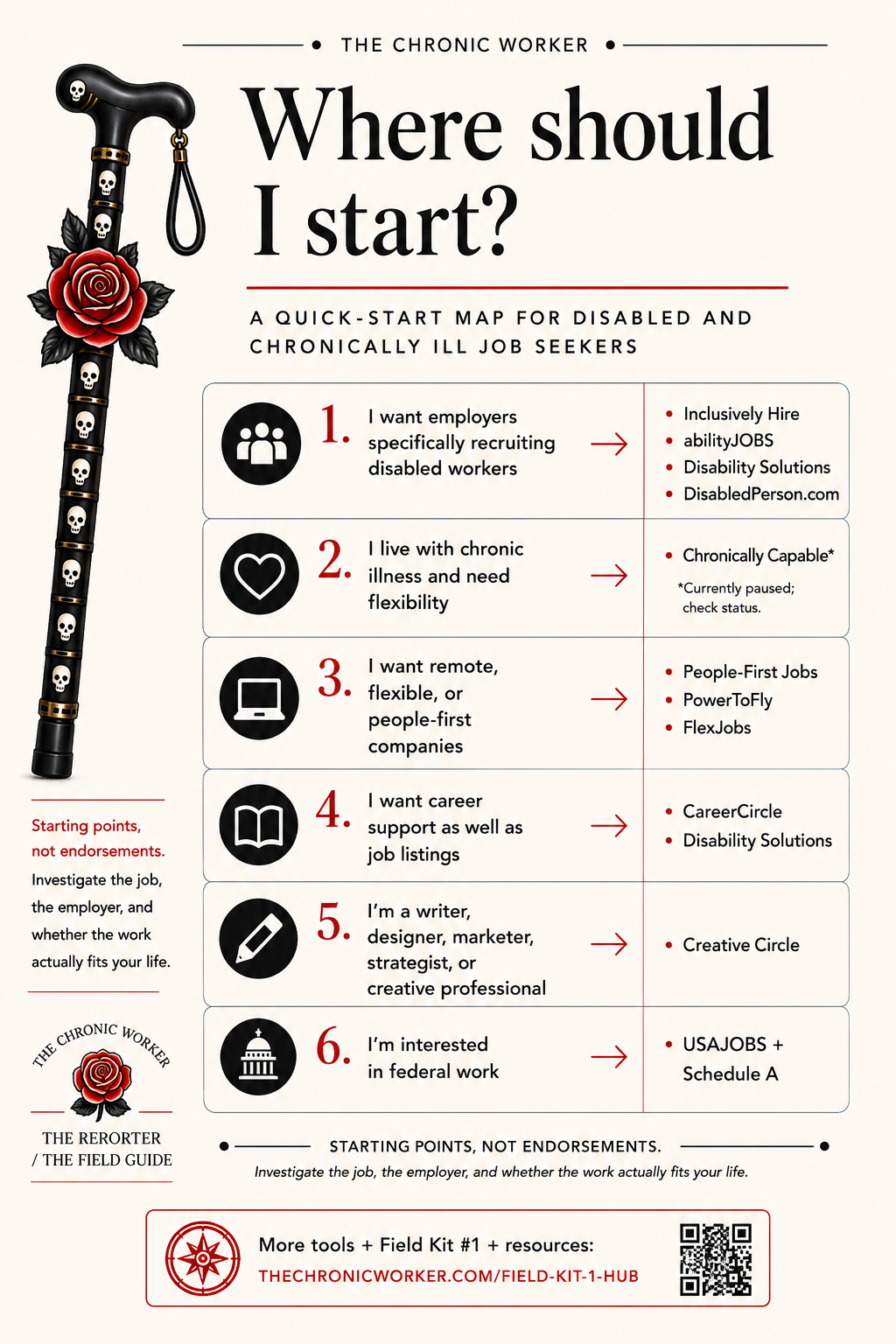
Bookmark this guide or send it to someone who needs a less overwhelming place to start.
Job boards built with disabled and chronically ill workers in mind
This is not a scientific ranking of the “best jobs for disabled people,” because there is no single job board—or single way of working—that will fit everyone.
I looked for some combination of:
- Active job board or employment pathway
- Current opportunities
- Explicit disability or chronic-illness focus where applicable
- Remote or flexible work options
- Job/career support
- Accessibility info
- Useful filtering or matching tools
- Working conditions that may reduce unnecessary barriers
I’ve also tried to be clear about what each site doesn’t tell you, especially because I have yet to use most of these myself (I'll make a note if I have!)
A disability-employment logo is useful, but it's not the same thing as knowing whether your future manager will lose their mind when you have a medical appointment on a Tuesday after lunch.
MORE FROM WORK + MONEY
Jobs are only one part of making work workable. Explore more from The Chronic Worker on employment, self-employment, accessibility, money, benefits, and redefining what contribution looks like.
1. Inclusively Hire
Best for: Job seekers who already know which accommodations, supports, benefits, or working conditions help them perform well.
Inclusively has changed quite a bit since I first wrote this guide in 2022. Its current recruitment platform is called Hire, and one of its most interesting features is something Inclusively calls Success Enablers.
Rather than matching people only on skills and job titles, job seekers can identify things that help them succeed at work—such as workplace supports, policies, technologies, benefits, flexibility, or accommodations. Employers can then describe which supports they offer.
That feels much more useful than waiting until you’re already struggling and then trying to reverse-engineer an accommodation.
Inclusively says you do not have to disclose your specific disability to create a profile, although the platform is designed for people who can benefit from accommodations under the ADA.
What I like
The matching model. Instead of treating accommodations as something you bring up only after you’ve already entered the hiring process, Success Enablers make working conditions part of the conversation much earlier.
What I’d check
Inclusively itself notes that requested Success Enablers are not guaranteed by an employer. Treat the matching information as useful evidence—not a binding promise.
2. abilityJOBS
Best for: Disabled job seekers who want a dedicated disability employment board plus career fairs and job-search resources.
abilityJOBS has been around since 1995 and remains a dedicated employment site for job seekers with disabilities. Job seekers can search current jobs, create alerts, manage resumes, and post an anonymous resume—which I find super interesting.
Also: the ABILITY Job Fair.
These are free, accessible online career fairs where disabled job seekers can communicate with recruiters through options including video, text, real-time captioning, and ASL interpretation.
For someone who finds traditional networking events physically inaccessible—or simply exhausting—that’s not a minor detail.
What I like
There’s a way in for everyone. You can quietly search listings and set alerts, or you can use the career-fair format when actually connecting with a human being would be more useful.
What I’d check
A disability-focused posting tells you that the employer is intentionally recruiting disabled talent, but it still doesn’t tell you how accessible the actual workplace is. I’d investigate flexibility, benefits, accommodation processes, and day-to-day expectations just as carefully as I would anywhere else.
3. Disability Solutions Career Center
Best for: Disabled job seekers who want listings plus interview support, webinars, resources, and employer connections.
Disability Solutions describes its Career Center as disability-focused rather than simply a general job board with an accessibility page attached.
Job seekers can browse thousands of listings, upload a resume, create job alerts, explore remote opportunities, and participate in interview-preparation training and other career resources.
Sometimes the problem isn’t simply finding a listing. It’s remembering how to do the whole bizarre dance of resumes, applicant tracking systems, interviews, disclosure decisions, and negotiating what you need.
What I like
The support doesn’t stop at, “Here are some jobs. Good luck out there.”
What I’d check
Because the platform combines job listings with broader career support, I’d still evaluate each employer independently. Disability-inclusive recruiting is encouraging, but it isn’t the same thing as knowing how accommodations, flexibility, or disability inclusion work once you’re hired.
4. Chronically Capable
Best for: Chronically ill and disabled workers interested in a platform built specifically around flexible, remote, part-time, full-time, and contract work.
Conceptually, this is still one of the most relevant resources on this entire list.
Chronically Capable was created specifically around the reality that talented people with chronic illnesses and disabilities may need different ways of working—not less meaningful work.
Its platform has connected job seekers with flexible and remote opportunities, including full-time, part-time, and contract roles. It also created Club Capable, a community with events, resources, and a private forum for chronically ill and disabled professionals.
What I like
The framing. Chronically Capable starts from “These workers are capable; the structure of work needs more flexibility,” rather than positioning disability employment as charity or a special favor.
That’s a big reason I’m keeping it in this guide.
What I'd check
Chronically Capable currently says it is taking a break. Its main site and job-seeker resources are still online, but as of August 2026, I couldn’t confirm that its job board was actively displaying new listings.
So consider this one a resource to bookmark and check back on, rather than the first place I’d send you for fresh job openings today.
If the active job board returns, I’d happily move it right back toward the top of this list.
5. DisabledPerson.com
Best for: A large, straightforward disability-specific job search.
DisabledPerson.com has been operating since 2002 and describes itself as a fully accessible disability job board.
One thing worth noting: the site says its listings are posted directly by employers rather than scraped from other websites. It also works with employers specifically interested in recruiting workers with disabilities.
The board covers a huge range of occupational categories, so this may be useful if the smaller niche platforms aren’t turning up roles in your field.
What I like
The scale and simplicity. If smaller niche boards aren’t turning up much in your field, this gives you a broader disability-specific search without immediately dropping you back into a giant general-purpose job site.
What I’d check
A company wanting to recruit disabled workers is encouraging.
It still tells you very little about what working there will actually feel like.
Look beyond the recruitment language and investigate policies, benefits, flexibility, management style, accommodation processes, and employee experiences where you can.
Hiring rather than job hunting? I’ve also written about why employers should be hiring more disabled workers.

Flexible and people-first job boards worth checking
These next sites aren't necessarily designed specifically for chronically ill or disabled workers.
That's an important distinction.
But they can still be useful because they help surface the kinds of working conditions many chronic workers are looking for.
6. People-First Jobs
Best for: People who care as much about how a company operates as the job title itself. This may be one of my favorite concepts on the list.
Disclosure: PFJ is a former client of mine (and they were lovely!)
People-First Jobs evaluates companies using criteria such as:
- Asynchronous communication
- Flexible schedules
- Remote-first or remote-friendly work
- Outcome-oriented management
- Deep-work culture
- Sensible working hours
- Professional development
- Diversity and inclusion
Now we're talking. Notice that none of those policies are exclusively disability accommodations. And that's partly the point.
A workplace designed around autonomy and results instead of chair time can remove a tremendous amount of unnecessary friction before anyone even files an accommodation request.
What I like
It helps you investigate work culture, not just openings.
What I'd check
“People-first” doesn't mean “disability-accessible.” A company can have a lovely remote culture and still have terrible health insurance, inaccessible software, or an inadequate accommodation process.
7. Creative Circle
Best for: Writers, designers, marketers, strategists, and other creative professionals looking for freelance, contract, temp-to-hire, or permanent work.
Creative Circle is a staffing and recruiting agency rather than a disability-specific job board, but it can be a useful route into project-based and contract work—especially if a conventional full-time job isn’t the only format you’re considering.
Its opportunities span writing, content, marketing, design, strategy, UX, and other creative fields, with a mix of freelance, contract, and permanent roles.
Disclosure: I’ve worked with Creative Circle on and off since late 2024.
What I like
Sometimes it helps to have another human being looking for opportunities on your behalf.
Staffing agencies can surface work you might not have found yourself, and project-based assignments can offer a lower-commitment way to test a client, workload, or way of working before signing up for something longer term.
What I’d check
Contract or freelance doesn’t automatically mean flexible.
The actual schedule, location, meeting load, workload and available hours, contract length, and accessibility expectations depend heavily on the individual client and assignment.
Ask the same questions you would of any other job before assuming a contract role will be easier on your body or brain.
Also worth checking if you work in creative, marketing, or digital fields: Aquent and Artisan Talent.
8. PowerToFly
Best for: Job seekers who want a larger pool of roles plus virtual networking and career events.
PowerToFly isn't disability-specific, but its job platform focuses on companies interested in building more diverse and inclusive teams.
You can currently search by experience level, job category, location, and work type—including remote, hybrid, and onsite roles. The platform also runs virtual career events and other professional-development programming.
Disclosure: I've participated as a speaker for one of their disabled worker-focused career events.
What I like
The combination of listings, networking, and virtual events. If cold-applying into an applicant tracking system feels like screaming into the void, the opportunity to actually encounter recruiters and employers in other formats can be useful.
What I’d check
PowerToFly is broader than disability employment, so “inclusive employer” still doesn’t necessarily mean “accessible employer.” I’d use the platform to expand your search, then investigate the actual flexibility, benefits, workload, and accommodation culture behind each listing.
9. Built In
Best for: Tech, marketing, design, product, operations, and other knowledge workers who want job listings plus more information about what an employer may actually be like to work for.
Built In started out heavily associated with tech and startups, and that’s still a major part of its identity, but the platform has grown into a pretty enormous job and company-research site. Built In currently says it carries more than 500,000 jobs, including dedicated remote listings, and its search tools let you filter by things like experience level, industry, company, and work arrangement.
What makes it especially useful for chronic workers, though, is the company information alongside the openings.
Employer profiles can include benefits, workplace model, compensation information, company culture, career-development policies, and more.
For example, Built In company profiles can surface things like health and mental-health benefits, parental leave, retirement benefits, professional development, and whether a company describes itself as remote, hybrid, or office-based.
What I like
You can investigate before you apply.
That’s useful when every application has an energy cost. If a company profile immediately tells you the work model, benefits, salary range, or culture won’t work for you, congratulations: you have just saved yourself an application.
Built In also has dedicated remote-job searches and company roundups focused on remote and flexible workplaces.
What I’d check
Built In is not disability-specific, and a detailed company profile is still largely information about how an employer describes itself. “Remote,” “flexible,” “great benefits,” and “excellent culture” are useful signals—not accessibility guarantees.
Use the additional information to ask better questions, not to skip the investigation.
10. CareerCircle
Best for: Job seekers who need guidance, skills support, or a career community in addition to listings.
CareerCircle describes itself as an inclusive career platform supporting multiple communities, including people with disabilities. Its free community includes job search, a resume builder, interview-preparation tools, virtual events and career fairs, training resources, and recruiter guidance.
What I like
It recognizes that job searching is a process. Not everyone shows up with the energy—or recent experience—to navigate that process alone.
What I’d check
Its broad, inclusive focus is a strength, but it also means the employers and opportunities won’t all be disability-specific. Use the career support aggressively, but still evaluate individual listings for the working conditions you need.
11. FlexJobs
Best for: People specifically prioritizing remote, hybrid, part-time, freelance, or otherwise flexible work. Unlike most resources on this list, full access is paid.
FlexJobs focuses on remote and flexible roles across dozens of career fields and says its team screens jobs and employers before adding them to the database. It includes full-time, part-time, freelance, remote, and flexible-schedule opportunities.
What I like
The curation. If your biggest job-search problem is spending limited energy sorting through scams, expired postings, or jobs that were never actually flexible in the first place, a screened database can reduce some of that noise.
What I'd check
FlexJobs is a paid subscription service, and full access to its job database requires a plan. Always check current pricing and features before you buy.
One major job board people forget: the federal government
12. USAJOBS + Schedule A
Best for: Disabled U.S. job seekers interested in federal employment.
USAJOBS isn't a disability job board, obviously. But disabled applicants can search specifically for federal jobs open to the Individuals with disabilities hiring path.
Some applicants may also qualify for Schedule A, a special hiring authority federal agencies can use to hire people with intellectual disabilities, severe physical disabilities, or psychiatric disabilities outside the traditional competitive process.
What I like
It gives disabled applicants a distinct hiring pathway rather than simply pointing them toward the same general application process. And because it’s part of the federal employment system, there are also disability-specific hiring resources and accommodation channels you can investigate.
What I’d check
Federal hiring is its own beast. Schedule A can create an additional pathway, but it doesn’t guarantee selection, and eligibility/documentation rules matter. I’d read the current USAJOBS guidance carefully before investing a lot of energy in applications.
What should I look for in a job listing?
Before you spend energy applying, use this checklist to look beyond “remote” or “flexible” and consider whether the job’s schedule, workload, benefits, accessibility, and culture might actually work for you.
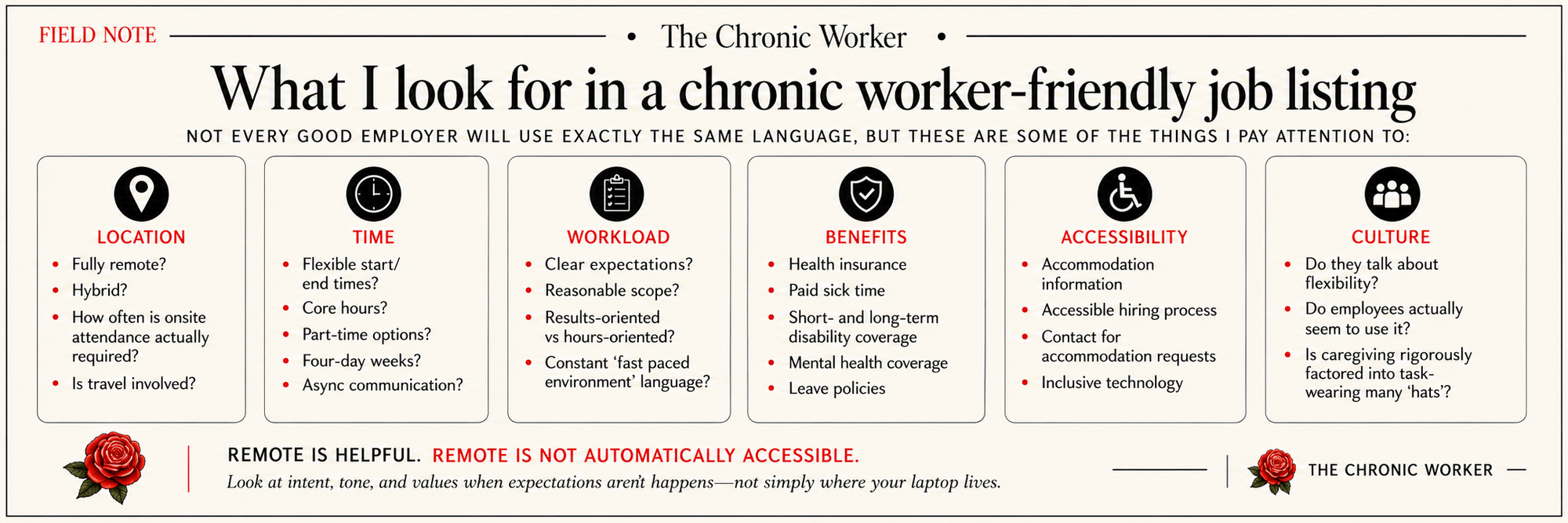
Before you spend your spoons applying…
I wish I could tell you that using a disability-focused job board solves the accessibility problem. It doesn't.
If job hunting is also colliding with unemployment systems, health insurance, and figuring out what kind of work you can actually sustain, I’ve written about that mess too: Disabled and unemployed. What’s next?
Before investing significant energy in an application, it can help to decide what you personally need from a job. Not what would be nice, but what makes the difference between workable and unsustainable.
You don't necessarily need to disclose any of this in your first application.
But you should know.
There's a huge difference between “Can I technically perform this job?” and “Can I perform this job repeatedly without destroying my life?” The second question matters.
SIPS Field Kit #1
Not sure what kind of work actually fits your capacity?
Before trying to optimize your entire life, it can help to observe what's already happening.
The Chronic Life Observation Toolkit is a low-burden Field Kit for tracking patterns in energy, symptoms, workload, recovery, and daily life—without turning yourself into a full-time science experiment.
Remote isn't automatically accessible
It can remove commuting, sensory, mobility, and environmental barriers. Awesome.
But a remote employer can also require you to sit on camera from 8 a.m. to 5 p.m., respond instantly to Slack, attend six meetings a day, and measure productivity by whether your little green dot is glowing.
That's not flexibility. That's an office with an electricity bill you're responsible for.
Look at when, how, and under what expectations work happens—not simply where your laptop lives.
You don't have to apply to everything
This is one I'm still learning myself. Job searching creates a horrible little scarcity voice that says: Maybe I should apply anyway.
There is nothing wrong with applying ambitiously.
But every application has a cost: time, attention, executive function, emotional energy, and sometimes, physical energy.
What if conventional employment isn't the only option?
Disabled workers are more likely to be self-employed than nondisabled workers. In 2025, 9.1% of employed disabled people were self-employed, compared with 5.9% of workers without disabilities.
I don't think the lesson is: Can't find an accessible job? Become self-employed! 🎉
Self-employment has its own access problems: inconsistent income, lack of employer-sponsored health insurance, administrative work, client acquisition, taxes, and the unfortunate discovery that your boss is now you—and she's an asshole with a terrible memory.
But for some of us, self-employment creates forms of control that traditional workplaces haven't. Control over schedule, environment, workload, and whether a bad symptom day requires asking another adult for permission to be sick.
That's part of what I explore in Chronically Self-Employed, my personal column about chronic illness, self-employment, identity, recovery, and building a more workable life.
TRYING TO MAKE WORK FIT YOUR BODY?
Finding the job is only part of it. I keep a living collection of strategies for managing energy, capacity, stress, and the workday when your body doesn’t operate on a neat schedule.
Finding work that leaves enough of you left
Four years after I originally published this guide, I'm still glad disability-focused job boards exist. But I've become a lot less interested in the idea of simply getting disabled people into jobs.
A job can look great on paper and still consume so much physical or cognitive capacity that everything outside work begins to collapse.
So yes, use the disability job boards. Ask for help. Apply for the job that looks slightly above your qualifications if you want to.
But we're allowed to ask for something more ambitious than employment at any cost:
A way of working that leaves enough of you left to have a life.
And if traditional work hasn't figured out how to offer that yet?
Well. That's what we're here for, isn't it?
What to do next
Evaluating an opportunity? Use the chronic-worker-friendly job listing checklist above to look beyond “remote” and consider schedule, workload, benefits, accessibility, and culture.
Already working and trying to make work fit your body? Read Self-management techniques for chronic workers for strategies around energy, capacity, stress, and the workday.
Want more tools like this? Get new disability-employment resources, field notes, and practical tools as they’re published.
Get new resources from The Chronic Worker
Get new disability-employment resources, field notes, and practical tools as they’re published.